



Bessieres
Context
Water Horizon is a Toulouse-based deeptech start-up founded in 2017. With its proprietary thermochemical technologies, Water Horizon aims to become a major player in the decarbonization of industry. WH supports manufacturers in their energy transition across several verticals: waste heat recovery, heat storage and transport, and renewable cooling production.
With its mature technologies, WH transforms the landscape into positive energy territory.
PARTIES INVOLVED
Bessières Greenhouses
Suez – Waste-to-Energy Unit Econotre
Bessières
PARTNERS
SUEZ
BUDGET
TOTAL COST:
3 million euros
Financing:
Water Horizon
ADEME
KEY NUMBERS
→ 792 US tons of CO2 avoided per year
→ Target of 1 GWh of energy
delivered per year
DESCRIPTION
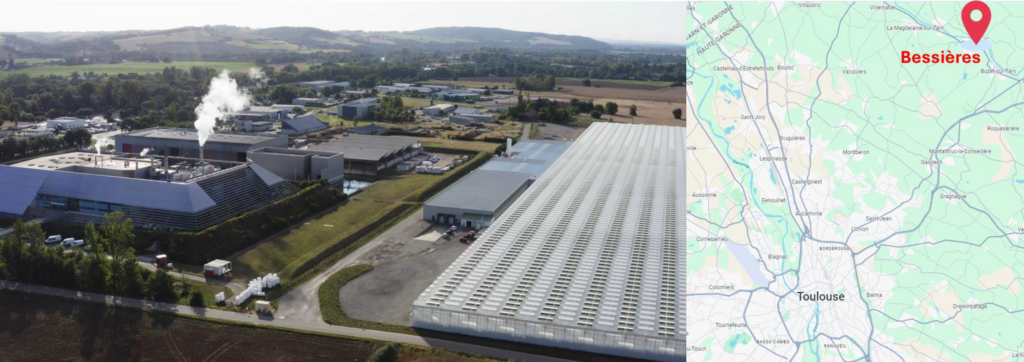
Thanks to its agricultural heritage, Bessières is ideally positioned to host an innovative project to establish a local and sustainable circular economy, connecting waste heat producers and cold consumers.
The Waste-to-Energy Unit is a facility for treating household and other waste.
The facility processes approximately 196,000 tons of waste annually, producing electricity and heat.
Part of this heat is recovered through a heating network for vegetable greenhouses. However, the recovery is still limited, and a large portion of this heat is lost and released into the air.
The Bessières Greenhouses, located a few hundred meters from the incinerator, is a market garden farm specializing in greenhouse tomato production. The greenhouses cover 10 hectares of land, yielding an average annual production of 6,000 tons of tomatoes. The need to maintain an adequate temperature for tomato preservation presents a major environmental challenge: the associated refrigeration requirements. Indeed, refrigeration systems, while essential for preserving tomato quality, contribute to energy consumption and greenhouse gas emissions.
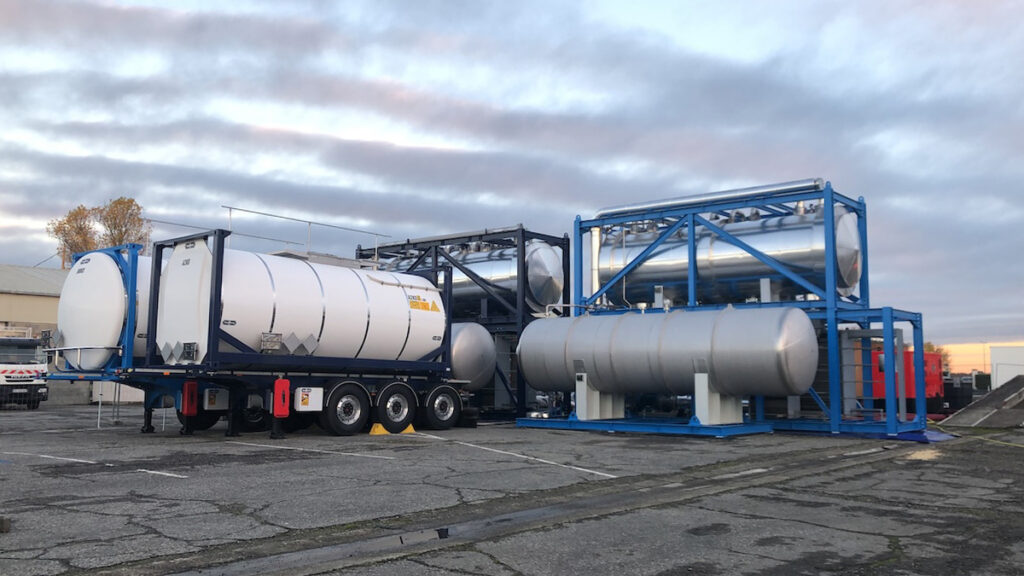
With its «Low Heat to Cold» (LH2C) thermal battery technology, Water Horizon will distribute renewable cold from the incinerator's waste heat.
The LH2C battery is charged using heat from the UVE. Once full, it is used on the same site to provide cold.
IMPACT
UVE of SETMI:
Better image
Reduced environmental impact
Upgrade and continuous innovation to meet changing regulations
Bessières Greenhouses:
Lower operating and maintenance costs (boilers and chillers)
Reduction of GHG emissions
Temperature management (accuracy, stability) to ensure the quality and safety of stored products
routing
TECHNOLOGY
For the past 7 years, WATER HORIZON has developed unique skills and technical expertise in waste heat recovery and renewable cooling production.
In Europe, industrial waste heat represents the equivalent of 100 nuclear reactors.
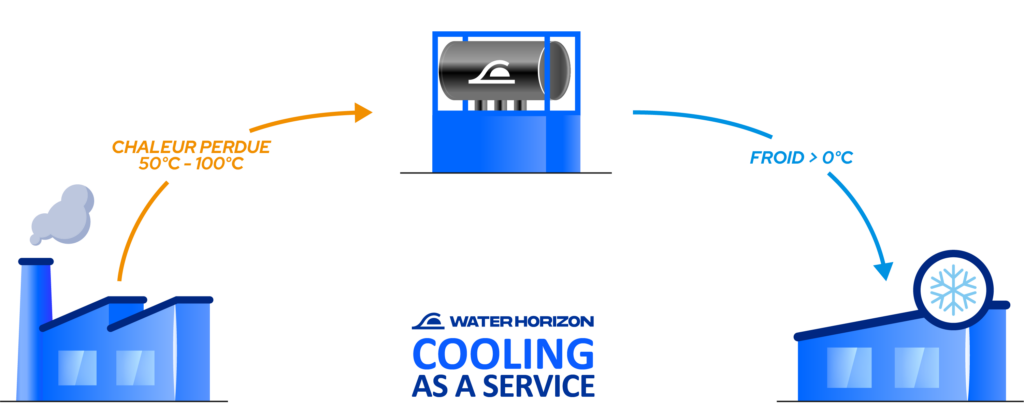
It is on the basis of this significant observation that Water Horizon has developed its Low Heat To Cold (LH2C) technology: Recover waste heat at low temperatures (50-100°C) and transform it at the same place into cold at a positive temperature (>0°C).
Water Horizon handles everything! Whether you're a producer or a consumer of waste heat, we'll find your partner, size the project, finance it, and operate it.
 Français
  English
  Español
  Italiano
  Deutsch (Sie)